-
0 前言
-
科技快速发展的时代背景下,冰箱、空调和飞机走入人民的生活,风力发电站作为新型环保能源惠及于民。人们生活质量得到巨大提升的同时,其结冰结霜现象严重影响换热器换热效率、增大能量损耗并减少机组设计寿命[1-3],尤其是飞机机翼结冰极易造成空难,风力发电叶片结冰若不能及时清除对工作效率和设备安全问题带来极大的隐患,因此有效抑制结冰结霜成为目前重要研究内容。在生物仿生学的启示下,越来越多的研究人员开始关注超疏水现象,这种现象表现为水滴在超疏水材料上的接触角大于 150°,滚动角小于 10°,这也可称为荷叶效应[4-6]。研究发现超疏水表面对结霜有延迟效果[7-9],是一种富有成效的抑霜方法,并且研究表明超疏水材料在防水[10]、表面自清洁[11-12]、防覆冰[13-15]、防腐[16]及油水分离[17]等方向也有着广泛的应用前景。
-
目前,超疏水涂层的制备策略有两类:① 用低表面能材料构造微纳粗糙表面;② 构建合适的粗糙表面,然后用低表面能材料修饰表面[18]。针对以上两种制备策略,当下相对成熟的制备方法有激光复合加工法、溶胶-凝胶法、自组装法、化学气相沉积法和化学刻蚀法等[19-24]。关于超疏水表面制备的相关研究已有许多报道,但如今超疏水表面仍未普及应用到实际,证明其研究仍有需要改进及深入的方面。首先制备方法方面,激光复合加工法和化学气相沉积法普遍制备步骤复杂、周期长、效率低以及技术成本太高;溶胶-凝胶法制备周期较长、材料成本高并且有害;自组装法和化学刻蚀法制备过程中要用到强腐蚀性的试剂,操作风险大,其污染环境问题难以解决。而喷涂法近年来更获得研究者的青睐,因为其成本低廉、操作简单、效率高及可大面积制备的特点可广泛应用在实际工业中[25-26]。其次制备选材方面,硅烷类因其优秀的低表面能特点被广泛应用于超疏水表面的制备,但其成本较高,且效果好的大多含氟基团对环境有污染性。脂肪酸类因其烷基链具有较低的表面能并且成本低廉、无污染,因此很多研究者尝试使用硬脂酸制备超疏水表面,结果表明其效果极佳。
-
以往研究者大多以宏观试验方法测定分析表面特性,但无法解释部分疏水原理以至缺失理论研究,仿真模拟的出现使以往不可实现的微观分子层面研究问题得到了解决,目前国内外对超疏水表面相关分子动力学模拟研究在许多报告中都可看到。 CHEN 等[27]通过分子动力学模拟对硬脂酸吸附氧化锌表面行为及水滴与表面的润湿性进行研究,结果表明水滴与亲水性表面的润湿涉及氢键的形成,硬脂酸改性氧化锌表面疏水作用涉及到烷基链之间相互作用力。HE 等[28]通过分子动力学模拟对 H-PFTEOS 分子与 TiO2分子表面的吸附行为进行研究,结果表明 H-PFTEOS 分子与 TiO2表面主要通过氢键形成吸附。然而这些报道缺少对低表面能物质改性机理与疏水机理的研究。
-
本文采用两步喷涂法制备一种低成本、无污染的棕榈酸(Palmitic acid,简称 PA)改性纳米 TiO2 制备的超疏水表面,通过宏观试验与微观分子动力学模拟相结合的方法对 PA 改性纳米 TiO2机理、不同改性配比对表面润湿性影响和疏水机理进行研究分析。试验与模拟的结合不仅互相佐证了研究的可行性,而且为超疏水表面制备方法与机理研究提供了依据。
-
1 试验
-
1.1 试验材料
-
纳米二氧化钛颗粒(TiO2,99.8%,25 nm,金红型)和棕榈酸(PA,分析纯 AR)购自上海阿拉丁生化科技股份有限公司;环氧树脂(98%)和聚酰胺树脂(PAI,12~25 Pa·s / 40℃)购自杭州五会港有限公司;7075 铝合金(15 mm ×15 mm ×5 mm,深圳市鸿年金属材料有限公司);无水乙醇 (CH3CH2OH)和丙酮(CH3COCH3)购自国药控股化学试剂有限责任公司。
-
1.2 纳米 TiO2超疏水涂层制备
-
超疏水表面制备可分为以下三步:
-
(1)制备超疏水涂料。首先将 0.2 g PA 和 40 mL 无水乙醇依次加入烧杯中,用玻璃棒简单搅拌后在常温下进行磁力搅拌 10 min,使 PA 完全溶解于无水乙醇,然后再称取一定量的纳米 TiO2(纳米 TiO2 与 PA 的质量比分别为 3∶2、3∶1、4∶1、5∶1、 6∶1)加入 PA 与无水乙醇的溶液中,将其在 50℃ 的条件下依次第一次磁力搅拌 30 min、置于磁力超声清洗器(KQ3200DE,上海十砚仪器设备有限公司)进行超声清洗 30 min 和第二次磁力搅拌 2 h 使 PA 与纳米 TiO2 颗粒充分结合。随后,分别称取 0.5 g 环氧树脂和聚酰胺树脂加入 20 mL 无水乙醇中,在常温下进行 30 min 的磁力搅拌。
-
(2)清洗基底。采用 800#、1000#、2000#砂纸将铝基初步抛光,将磨好的铝基在 P-2 金相样品抛光机上进行最终的抛光,目的是除去其表面致密的氧化膜,降低铝合金表面的粗糙度和表面的加工痕迹。将抛光完成的铝合金块依次置于丙酮溶液和无水乙醇中进行超声清洗,清洗温度为 28℃,时间为 10 min。清洗的目的是去除基底上的杂质、污垢及各种油脂,防止对后续试验造成影响。经过清洗后,将铝基取出以 60℃的温度在电热恒温鼓风干燥箱 (GZX-9140MBE,无锡玛瑞特科技有限公司)中干燥 20 min 烘干备用。
-
(3)喷涂。试验采用两步喷涂法制备超疏水表面,首先将树脂悬浮液以 1 MPa 压力喷涂于烘干后的铝基表面,置于烘箱中 80℃烘干 30 min 后取出,将改性完成的纳米 TiO2 颗粒悬浮液以 0.8 MPa 的压力喷涂到铝基上,将喷涂完成的铝基置于烘箱中以 100℃温度烘干 2 h 得到超疏水表面。
-
1.3 样品表征
-
采用 SEM 扫描电子显微镜[Merlin Compact, Carl Zeiss NTS GmbH(德国)]对制备的超疏水表面进行形貌表征。采用 FT-IR 傅里叶红外光谱仪 (WQF-520,天津市能谱科技有限公司)分析 TiO2 纳米颗粒与 PA 的化学反应,因仪器仅能检测粉末状的样品,须将改性完成的纳米 TiO2 颗粒悬浮液进行洗涤抽滤,利用烘箱将得到的粉末烘干备用。采用光学接触角测量仪 (SZ-CAMC13,上海轩准仪器有限公司)测试表面接触角和滚动角来评估样品的润湿性能。
-
2 模拟部分
-
本文模拟主要采用 Materials Studio(MS)软件包中的 Amorphous Cell 模块和 Forcite Plus 模块。本节主要介绍模型的构建、参数设定及分子动力学模拟的详细步骤。
-
2.1 建模与参数设定
-
图1a 为 PA 分子模型,可以看出 PA 分子由烷基链与羧基基团组成,其中羧基上的 H 原子电荷为 0.41e(e 为基本电荷,通常 e=1.6×10⁻¹⁹ C),O 原子电负性较强,1 号 O 原子电荷为−0.455 e,2 号 O 原子电荷为−0.45 e,极易与图1b 所示的纳米 TiO2 (1 0 1)表面之间形成氢键,本文中所述的低表面能改性就是此原理,将 PA 与 TiO2通过缩合反应连接在一起,使亲水性的纳米 TiO2 改性为疏水性。图1c 为半径为2.2 nm且由1 000个水分子组成的水团簇,作为表面润湿性模拟的液滴。
-
图1 分子模型图
-
Fig.1 Molecular diagram
-
首先构造 TiO2 分子层,利用 Visualizer 工具从数据库中导入金红石型 TiO2 晶体,其晶格参数为 a=b=0.459 4 nm,c=0.295 9 nm,α =β=γ= 90°;切取 (1 0 1)晶面后超晶胞得到尺寸为 5.48 nm×5.28 nm 的表面;对得到的表面施加真空层,TiO2 分子表面模型构建完毕。将 TiO2分子表面模型作为 Layer 1,水团簇模型作为 Layer 2 层,并且加 4 nm 的真空层防止周期性边界影响,得到水团簇润湿模型如图2 所示。
-
本文所有模型构建及模拟计算采用目前应用最广泛的、高精度的 COMPASSⅡ力场,模拟前,固定 TiO2 分子表面模型中所有的原子坐标。首先开始结构优化,算法选择最速下降法和共轭梯度法各进行最大限度 10 000 步的几何优化,其目的是根据热力学的能量最低原理得到符合实际状态的模型。然后进行分子动力学模拟,体系设置为恒容恒温 (NVT)系综,温度为 298 K,以 Nose-hoover 算法来控制体系温度,通过麦克斯韦—玻尔兹曼分布随机得到体系中分子的运动速度及位置分布。表达式为:
-
图2 水团簇润湿初始构型
-
Fig.2 Initial configuration of water cluster wetting
-
式中,ν 为分子速度,n 为分子数密度,m 为分子质量,k 为玻尔兹曼常数,T 为系统温度。
-
系综条件为周期性边界,采用 Velocity-Verlet 算法计算分析求解体系的运动方程,能量偏差为 209.2 MJ / mol。在求和计算中,静电作用力 (Elactrostatic)基于 Ewald 进行计算;范德华作用力 (van der Waals)基于 Atom based 进行计算,截断半径为 1.55 nm。
-
2.2 分子动力学模拟方法
-
分子动力学模拟可分为以下三个部分:
-
(1)建立乙醇分子模型通过 Amorphous Cell 模块建立 PA—乙醇溶液盒子,盒子由 2 000 个乙醇分子和 1 个 PA 分子组成,再通过 build layers 建立层,将溶液盒子置于 TiO2 分子层上方,模拟 PA 在乙醇溶液中在 TiO2 表面上的吸附情况。
-
(2)将水团簇置于 TiO2分子层上方,模拟水滴在 TiO2 表面的润湿情况。
-
(3)第一步,模拟不同数量的 PA 分子在二氧化钛表面上的吸附情况;第二步,将吸附在二氧化钛表面的 PA 通过 Constraints 固定坐标,再通过建层将水团簇置于上方,模拟 PA 与水团簇的润湿情况。
-
3 结果与分析
-
3.1 纳米 TiO2颗粒改性机理
-
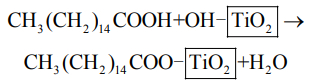
为了研究纳米 TiO2 颗粒改性机理,分别对改性前后的纳米 TiO2 颗粒做了傅里叶红外光谱分析,得到如图3 所示结果,改性前后相同的峰在 500 cm−1 处,此处为 O−Ti 键特征吸收峰。改性后在 2 921和 2 852 cm−1 处出现两个纳米 TiO2 曲线没有的峰,这两个峰为甲基(−CH3)和亚甲基(−CH2−)特征吸收峰,此现象表明具有烷基链的 PA 分子已吸附在 TiO2 分子上;在 1 501 和 1 468 cm−1 处改性后曲线出现未改性曲线不具有的峰,此为酯基(O−C=O) 收缩振动峰,此现象表明 PA 分子与 TiO2分子发生脱水缩合反应。由此从红外光谱可以得出结论,纳米 TiO2颗粒改性机理为 TiO2与 PA 发生了脱水缩合反应,在 TiO2 上成功地形成了疏水基团,其化学反应式为:
-
图3 纳米 TiO2改性前 / 后的红外光谱图
-
Fig.3 Infrared spectra of nano-TiO2 before / after modification
-
通过分子动力学模拟在微观上对改性过程进行模拟,图4a~4d 展示了任意位置的 PA 分子在乙醇溶液中不同时刻吸附在 TiO2(1 0 1)晶体表面的 MD 模拟。图4a 所示为 0 ps 时的初始模型,PA 分子在乙醇溶液的环境下并未与 TiO2(1 0 1)晶体表面接触,当 100 ps 时如图4b 所示,PA 分子的头部羧基部分与 TiO2 表面的 O 原子吸附在一起,而后如图4c、4d 在 300~500 ps 时 PA 的烷基链由于其烷基基团疏水特性被甩离表面并且来回摆动,为研究吸附后 PA 分子在表面的状态及运动轨迹,可通过均方根位移(Mean squared displacement,MSD)计算体系中 PA 分子在 300~500 ps 时间段的运动轨迹。首先其意义为:随着时间变化粒子移动后的位置与初始位置偏差的度量。均方根位移 XMSD数学表达式为:
-
式中, N 为体系中总粒子数, t 为时间,代表粒子 i 在一段时间 t 内位移的矢量距离。
-
图5 为 PA 分子在吸附过程中分别在总方向上,X、Y 和 Z 轴的均方根位移示意图,可以看到 PA 分子在 Z 轴上只有轻微位移,在 Y 轴,上稍微比 Z 轴上位移幅度大,再看 X 轴,可以看出 PA 分子在 X 轴上的位移幅度很大,因为其吸附在 TiO2 晶体表面,且在 X 轴上的移动引起 PA 分子在 Z 轴上小幅度的位移。所以可得出结论:PA 分子吸附在 TiO2 晶体表面后烷基链总体上甩离表面,尾部在上并且左右摆动,正是由这种吸附形式导致表面上形成由烷基链组成的疏水膜,改变了表面原始亲水的性质。
-
图4 不同时刻 PA 分子改性 TiO2模拟快照
-
Fig.4 PA molecular modified TiO2 simulation snapshot at different times
-
图5 吸附过程中 PA 分子的均方根位移
-
Fig.5 Root mean square displacement of PA molecules during adsorption
-
由以上研究了解到 PA 分子吸附在表面上的运动轨迹及疏水原理,进一步研究 PA 分子是如何吸附的,其中涉及到分子间相互作用力,可通过计算 PA 羧基中 H 原子与 TiO2(1 0 1)晶体表面中 O 原子的径向分布函数(Radial distribution function,RDF) 去分析两者之间的相互作用力类型。径向分布函数的意义是在给定某个原子坐标的情况下,其他原子出现在给定原子周围的概率[29],通常可以用来研究体系的有序性及电子的相关性,径向分布函数 g(r)的数学表达式为:
-
式中, Nα、 Nβ 分别表示两种原子的数量,V 表示体系的体积,表示当第 i 个原子为中心时,在 r 到 r+1 范围内 β 原子出现的数量。
-
图6 为 PA-乙醇溶液-TiO2模拟体系中 PA 羧基H 原子与 TiO2(1 0 1)晶体表面中 O 原子的 RDF 随着距离变化的示意图。可以看出,第一个波峰的峰值横坐标为 1.73 Å,由此可知 PA 分子与 TiO2 晶体表面中 O 原子主要是通过氢键作用吸附,已知氢键距离为 1.1~2.5 Å,氢键连接如图6 右上方的图所示。
-
图6 PA 羧基中的 H 原子与 TiO2(1 0 1)中 O 原子的 RDF
-
Fig.6 RDF of H atom in PA carboxyl group and O atom in TiO2 (101)
-
根据傅里叶红外光谱所得结果,可知 PA 改性 TiO2 涉及到化学键的改变,然而通过模拟了解到其吸附作用是通过氢键这种分子间的作用力,目前国际上定义氢键是一种比范德华力稍强的一种作用力,所以氢键不属于化学键。综合分析可得出 PA 改性 TiO2 的机理为:首先 PA 分子通过氢键吸附在 TiO2 晶体表面的 O 原子上,然后 PA 分子与 TiO2进一步发生脱水缩合反应,脱去一个水分子并生成化学键—酯键,通过这种方式成功地在 TiO2 上形成低表面能的疏水基团,从而实现材料亲水性改变为疏水性的属性改变,其原理如图7 所示。
-
图7 PA 改性 TiO2分子层原理示意图
-
Fig.7 Schematic diagram of the principle of PA modified TiO2 molecular layer
-
3.2 不同配比对涂层润湿性的影响
-
用不同配比的 PA 将纳米 TiO2改性制备得到具有不同润湿性的超疏水表面,研究各改性配比对表面润湿性的影响,以此得到最佳配比制备的效果最佳的超疏水表面,研究结果如图8 所示。当 PA 质量不变而纳米 TiO2 质量不断增加时,水滴与表面的接触角逐渐增大,当 PA 与纳米 TiO2的质量分别为 0.2 g 和 1 g 时接触角达到最大值 164.4°,此时滚动角也达到最小值 2°;而后纳米 TiO2 质量继续增大接触角逐渐降低,滚动角逐渐增大。由此证明在无水乙醇溶液为 40 mL、PA 为 0.2 g 与纳米 TiO2 为 1 g 时,制备的表面超疏水性能最好。基于此,研究无水乙醇溶液体积不变,固定纳米 TiO2质量为 1 g,增加 PA 质量的情况下对表面润湿性的影响,可以看出随着 PA 质量的增加表面的润湿性能逐渐下降。由此得出结论:在固定无水乙醇溶液为 40 mL 时, PA 为 0.2 g 与纳米 TiO2 为 1 g,制备的表面超疏水性能最好。
-
图8 不同质量 PA-纳米 TiO2制备得到表面的接触角与滚动角
-
Fig.8 Contact angle and rolling angle of surfaces obtained from PA-nano-TiO2 preparation with different weights
-
通过扫描电子显微镜(SEM)来表征各改性配比制备得到表面的形貌如图9 所示,以此研究不同配比对涂层润湿性的影响。当 PA 和 TiO2 质量分别为 0.2 和 0.3 g 时,表面生成粗糙的微纳结构,但纳米颗粒相对分散。PA 质量不变,当 TiO2 质量增加到 0.6 g 颗粒团聚使微观结构更加完善, TiO2质量为 1 g 时微观结构呈现规则的微纳结构,其颗粒团聚形成的空隙可储存空气使固液接触面积减少。然而 TiO2 质量的继续增加如图9d 所示,过多的颗粒掩盖了微纳结构导致无法储存空气增大固液接触面积,因此 0.2 g PA 改性下 1 g TiO2 形成的表面结构最合理,效果也最好。当增加 PA 质量为 0.4 g 时,TiO2 质量为 1 g,形成的表面结构比较粗大,这是因为过量的 PA 修饰使 TiO2 颗粒被过度包裹,其粒径过大破坏了表面精致的粗糙结构,使表面疏水性下降。因此从微观形貌上解释了不同配比对涂层润湿性的影响以及筛选到最佳改性配比。
-
经上述分析,进一步通过分子动力学模拟在微观分子尺度上研究不同配比对表面润湿性的影响。首先在超晶胞 TiO2(1 0 1)表面的 50Å 真空层分别放置 225、272、320 个 PA 分子,完成结构优化后开始 500 ps 的分子动力学模拟,最终得到图10 所示的构型。如图10 所示,当 PA 分子数较低时,分子因分子间的相互作用力以倾斜的状态吸附于超晶胞 TiO2(1 0 1)表面,随着 PA 分子数量的增加其吸附趋向垂直于表面。当增加至 320 个 PA 分子时,可以发现吸附在表面上的 304 个分子基本垂直于表面,但有 16 个分子并未吸附在晶胞表面,随着模拟时间的增加,未吸附的分子逐渐覆盖在 PA 分子上方。
-
图9 不同改性配比下的 SEM 图像对比
-
Fig.9 SEM image comparison under different modification ratios
-
图10 不同数量 PA 分子吸附于超晶胞 TiO2(1 0 1)表面的快照,未吸附的 PA 分子以黄色标出
-
Fig.10 Snapshot of different amounts of PA molecules adsorbed on the surface of hypercrystalline TiO2 (101) with unadsorbed PA molecules highlighted in yellow
-
通过上述模拟,将从两方面分析。第一个方面为吸附能,吸附能 Eint 的数学表达式为:
-
式中,ET 为体系总能量,EA 为表面的总能量,EB 为改性物质的总能量。计算出吸附能后再平均算一下每个 PA 分子与表面的吸附能。经计算得到,当 225、272 和 304 个 PA 分子吸附在表面上时,平均每个分子与表面的吸附能为 69.904、66.974 和 65.718 kJ / mol。根据结果可知,随 PA 分子数量的增加,其与表面的吸附能在降低,表明充足的 PA 充分改性纳米 TiO2 时所制备表面的表面能会进一步降低。
-
第二方面为过量的 PA 修饰表面对润湿性的影响。在接触角测量数据中可发现,更多 PA 修饰并未使表面的超疏水性能进一步提高,相反降低不少,在 SEM 表征中分析到过量的 PA 修饰使表面微纳结构较大,使微槽被覆盖或填满,导致空气无法滞留从而降低表面的超疏水性能。在微观分子尺度上,通过分子动力学模拟进一步分析过量的 PA 修饰表面对润湿性的影响。首先选取 320 个 PA 分子吸附表面模拟的最后一帧与水团簇建层,然后进行 200 ps的分子动力学模拟,其最后一帧所示构型如图11a 所示。由图11b 可知,随着模拟的进行,未吸附的 PA 分子头部羧基与水分子通过氢键连接起来,从微观分子尺度上回答了过量 PA 修饰表面导致超疏水性能下降的问题。
-
图11 过量 PA 修饰 TiO2润湿性模拟以及水滴与 PA 分子中 O 原子的 RDF
-
Fig.11 Excessive PA modified TiO2 wettability simulation and RDF of water droplets and O atoms in PA molecules
-
由以上分析可知,不同的改性配比对表面润湿性有巨大的影响,筛选出最佳配比对研究及应用都有着至关重要的作用,故以下研究选择 PA 分子最高数量为 304 个对表面改性。当不同数量 PA 分子膜吸附完成后,通过建层将水团簇置于表面上方,得到表面润湿模型,最后进行 500 ps 的分子动力学模拟进行分析。模拟快照如图12a、12b 所示,可以看到无改性的情况下水团簇在 75 ps 时就完全在表面铺展开,然而经改性的表面在 500 ps 时间内水团簇一直维持椭圆形态并未发生形态变化。由此可得出结论:PA 分子成功改性亲水性 TiO2为疏水性。并且模拟结果与实际中铝基表面、超疏水表面润湿特性一致,证明了模拟中构建的模型与方法的合理性。
-
图12c 为不同数量 PA 分子改性 TiO2表面润湿模型中水分子在 Z 轴方向上的分布情况,经对比可以看出,在不含 PA 的 TiO2 表面,其最强峰又高又窄,并且峰值为 9.56 Å,反映水分子高度分散在距离表面 9.56 Å 处,意味着水分子在表面铺展开,佐证了未改性的 TiO2 亲水的特性,这与图12a 中水团簇润湿模拟构型一致。当 PA 分子数量为 225 个时,其第一峰位置右移至 31 Å 处,并且水分子主要分布在 31~48 Å 区域,证明水分子高浓度区域远离表面已具有超疏水特性。当 PA 分子数量为 304 个时,其第一峰位置又右移至 35 Å 处,由此佐证了 PA 改性 TiO2 为疏水性是成功的,并且不同比例改性物对表面润湿性有着至关重要的作用。
-
图12 润湿性模拟及润湿液滴相对浓度
-
Fig.12 Wettability simulation and relative concentration of wet droplets
-
3.3 性能测试
-
制备完成后将接触角为 164.4°的表面置于一般大气环境下,如图13a 所示,4 月后测得其接触角为 160.5°,6 月后测得其接触角为 160°,其超疏水性并未明显降低,可说明制备的表面具备优秀的耐持久性。
-
如图13b 所示,将制备好的表面放入水中浸泡,因涂层表面超疏水性质,水不能润湿表面,并且在表面上形成一层水膜,因水的折射现象,在水中的表面像银色的镜子一样。浸泡 5 d 后将表面拿出干燥,测得其接触角为 156.6°。由以上两个测试可证明 PA 改性 TiO2制备的表面优秀的耐持久性与稳定性。
-
图13 性能测试图
-
Fig.13 Performance test diagram
-
4 结论
-
(1)针对目前制备超疏水表面的方法大多工艺繁琐、技术及材料成本高、易污染环境环境的问题,通过两步喷涂法制备一种低成本、无污染、制备简单的 PA-纳米 TiO2 超疏水表面,其接触角可达到 164.4°,滚动角为 2°。
-
(2)针对目前研究者大多以宏观试验方法测定分析表面特性,其改性机理及疏水机理研究仍不够完善的问题,采用微观分子动力学模拟方法与宏观试验方法相结合的研究方法,综合分析得到其改性机理:首先 PA 分子通过氢键吸附在 TiO2晶体表面的 O 原子上,然后 PA 分子与 TiO2 进一步发生脱水缩合反应形成化学键连接,成功改性。以及其疏水机理:改性后的表面上 PA 分子烷基链甩离表面时形成一层低表面能的疏水膜。
-
参考文献
-
[1] 席林,吴涛.热泵空调室外换热器结霜研究[J].汽车科技,2019(3):46-51.XI Lin,WU Tao.A review on frosting of outdoor heat exchanger in heat pump air conditioning[J].Automobile Science & Technology,2019(3):46-51.(in Chinese)
-
[2] 杨钦,罗荘竹,谭生,等.超疏水自清洁涂层防结冰技术的研究进展[J].中国表面工程,2016,29(4):10-22.YANG Qin,LUO Zhuangzhu,TAN Sheng,et al.Research progress in anti-icing technology of superhydrophobic self-cleaning coating[J].China Surface Engineering,2016,29(4):10-22.(in Chinese)
-
[3] 王帅,司伟,丁超.硅烷偶联剂改性无机氧化物超疏水涂层的研究进展[J].中国陶瓷工业,2023,30(1):26-31.WANG Shuai,SI Wei,DING Chao.Research progress of silane coupling agent modified superhydrophobic coatings[J].China Ceramic Industry,2023,30(1):26-31.(in Chinese)
-
[4] 李玉峰,高文博,史凌志,等.超疏水涂层的制备及其对 Mg-Li 合金的防腐蚀性能[J].中国表面工程,2020,33(5):1-9.LI Yufeng,GAO Wenbo,SHI Lingzhi,et al.Preparation of superhydrophobic coating and its corrosion resistance to Mg-Li alloy[J].China Surface Engineering,2020,33(5):1-9.(in Chinese)
-
[5] 薛鑫宇,尹正生,蒋永锋,等.碳钢表面防腐超疏水 TiO2/PDMS 涂层的制备及性能[J].中国表面工程,2021,34(4):53-59.XUE Xinyu,YIN Zhengsheng,JIANG Yongfeng,et al.Preparation and properties of TiO2/PDMS anticorrosion superhydrophobic coating on carbon steel[J].China Surface Engineering,2021,34(4):53-59.(in Chinese)
-
[6] 范鹏艳,刘中良,李艳霞.基于纳米 SiO2 的透明疏水表面制备与抑霜性能研究[J].制冷与空调(四川),2021,35(3):312-320.FAN Pengyan,LIU Zhongliang,LI Yanxia.Preparation and defrost of transparent hydrophobic surface based on Nano-SiO2[J].Refrigeration and Air Conditioning,2021,35(3):312-320.(in Chinese)
-
[7] 何桂香,谷雅秀,段佳慧.空气源热泵超疏水抑霜的机理分析及性能研究[J].西安建筑科技大学学报(自然科学版),2021,53(6):860-866.HE Guixiang,GU Yaxiu,DUAN Jiahui.Mechanism analysis and performance research on superhydrophobic frost suppression of air source heat pump[J].Xi’ an University of Architecture & Technology,2021,53(6):860-866.(in Chinese)
-
[8] 汪峰,汤锐,王志豪,等.冷表面温度对超疏水翅片结霜特性与抑霜性能的影响[J].制冷学报,2022,43(6):107-113.WANG Feng,TANG Rui,WANG Zhihao,et al.Effects of cold surface temperature on frosting characteristics and anti-frosting performance of superhydrophobic fins[J].Refrigeration,2022,43(6):107-113.(in Chinese)
-
[9] ZHAO J C,ZHANG T,LI Y M,et al.Fluorine-free,highly durable waterproof and breathable fibrous membrane with self-clean performance[J].Nanomaterials,2023,13(3):516.
-
[10] LU H,ZHENG C X.Comparison of dust deposition reduction performance by super-hydrophobic and super-hydrophilic coatings for solar PV cells[J].Coatings,2022,12(4):502.
-
[11] KURBANOVA A,MYRZAKHMETOVA N,AKIMBAYEVA N,et al.Superhydrophobic SiO2/trimethylchlorosilane coating for self-cleaning application of construction materials[J].Coatings,2022,12(10):1422.
-
[12] ZHAO Z H,CHEN H W,ZHU Y T,et al.A robust superhydrophobic anti-icing/de-icing composite coating with electrothermal and auxiliary photothermal performances[J].Composites Science and Technology,2022,227:109578.
-
[13] LI W,ZHAN Y L,YU S R.Applications of superhydrophobic coatings in anti-icing:Theory,mechanisms,impact factors,challenges and perspectives[J].Progress in Organic Coatings,2021,152:106117.
-
[14] BAO Y,YANG H,GAO L,et al.Fabrication of anti-icing/de-icing superhydrophobic composite coating based on hydrangea-like ZnO@CuS[J].Solar Energy Materials and Solar Cells,2022,245:111838.
-
[15] HASSAN N,LU S X,XU W G,et al.Fabrication of Ag-Fe3O4/Fe superhydrophobic surface on galvanic sheet for its application[J].Journal of Solid State Chemistry,2018,266:121-132.
-
[16] YANG Y,ZHAO X W,YE L.Facile construction of durable superhydrophobic cellulose paper for oil–water separation[J].Cellulose,2023,30(5):3255-3265.
-
[17] WANG X T,CHEN K X,LIU Y,et al.Preparation and application of biodegradable and superhydrophobic polylactic acid/carnauba wax coating[J].Progress in Organic Coatings,2023,177:107434.
-
[18] GE-ZHANG S J,YANG H,NI H M,et al.Biomimetic superhydrophobic metal/nonmetal surface manufactured by etching methods:A mini review[J].Front Bioeng Biotechnol,2022,10:958095.
-
[19] NGO C,CHUN D M.Effect of heat treatment temperature on the wettability transition from hydrophilic to superhydrophobic on laser-ablated metallic surfaces[J].Advanced Engineering Materials,2018,20(7):1701086.
-
[20] ZHENG J W,YANG J C,CAO W,et al.Fabrication of transparent wear-resistant superhydrophobic SiO2 film via phase separation and chemical vapor deposition methods[J].Ceramics International,2022,48(21):32143-32151.
-
[21] ZHU Z T,TIAN Y,LIU Y B,et al.Facile synthesis of superhydrophobic coating with icing delay ability by the self-assembly of PVDF clusters[J].Colloids and Surfaces A:Physicochemical and Engineering Aspects,2022,641:128562.
-
[22] ZHOU B M,WU Y H,ZHENG H Y.Investigation of electrochemical assisted deposition of sol-gel silica films for long-lasting superhydrophobicity[J].Materials,2023,16(4):1417.
-
[23] CHEN W J,SHI H R,LIU W W,et al.Study on the preparation and corrosion resistance properties of superhydrophobic coatings on galvanized steel[J].Metals,2023,13(2):260.
-
[24] XING L,XIA T,ZHANG Q X.Effect of hydrophobic Nano-SiO2 particle concentration on wetting properties of superhydrophobic surfaces[J].Nanomaterials,2022,12(19):3370.
-
[25] WANG T L,GUO Q,ZHANG T C,et al.Large-scale prepared superhydrophobic HDTMS-modified diatomite/epoxy resin composite coatings for high-performance corrosion protection of magnesium alloys[J].Progress in Organic Coatings,2022,170:106999.
-
[26] HAO X R,XIE J,ZHANG Y,et al.Preparation of SiO2 resin coating with superhydrophobic wettability and anti-icing behavior analysis[J].RSC Adv,2022,12(52):33626-33633.
-
[27] CHEN X W,WANG M Y,XIN Y,et al.One-step fabrication of self-cleaning superhydrophobic surfaces:A combined experimental and molecular dynamics study[J].Surfaces and Interfaces,2022,31:102022.
-
[28] HE X Y,LOU T,YANG Z C,et al.Lubricant-infused titania surfaces with high underwater transparency for antifouling applications:A combined experimental and molecular dynamics study[J].Applied Surface Science,2021,543:148848.
-
[29] TANG F J,OHTO T,SUN S M,et al.Molecular structure and modeling of water-air and ice-air interfaces monitored by sum-frequency generation[J].Chemical Reviews,2020,120(8):3633-3667.
-
摘要
目前超疏水表面制备方法众多,但其改性机理及疏水机理研究仍不够完善。通过棕榈酸改性纳米 TiO2制备一种高效超疏水表面并分析其改性和疏水的机理。试验上按不同改性配比制得悬浮液,通过两步喷涂法将悬浮液喷涂到铝基表面制备得到超疏水表面,并采用傅里叶红外光谱仪和扫描电子显微镜进行表征与分析。研究中采用分子动力学模拟方法构建棕榈酸改性纳米 TiO2模型和润湿模型,使用 COMPASS Ⅱ 力场进行分子动力学模拟,通过体系构型以及均方根位移和径向分布函数的计算结果对改性机理、不同改性配比效果及微观润湿行为进行分析研究。经试验与模拟的验证,不同的改性配比形成不同的微纳结构对表面润湿性有着极大的影响,通过表征测试筛选得到最佳改性配比,成功改性制备得到接触角为 164.4°的超疏水表面。经分析可知,棕榈酸与纳米 TiO2 通过氢键吸附发生脱水缩合反应产生酯键,成功将亲水性的纳米 TiO2 改性为超疏水性,改性配比制备的表面不仅表面能低,而且形成层次分明的微纳结构使得表面超疏水性能更佳。通过宏观试验与微观分子动力学模拟相结合的方法研究分析得到 PA 改性纳米 TiO2 机理、不同改性配比对表面润湿性影响和疏水机理,进一步完善制备超疏水表面的相关机理研究,在超疏水表面制备及研究方面具有参考意义。
Abstract
Several methods are available for preparing superhydrophobic surfaces. However, their practical applications are limited owing to imperfections in their modification and hydrophobicity mechanisms. Therefore, investigating the mechanisms underlying the formation of superhydrophobic surfaces is crucial. Additionally, the preparation method and material selection for superhydrophobic surfaces have a significant impact on cost and environmental considerations. In this study, we chose palmitic acid (PA)-modified titanium dioxide (TiO2), which has a low surface energy and is environmentally friendly and cost-effective. Our objective was to prepare a highly efficient superhydrophobic surface using this material and analyze its modification and hydrophobicity mechanisms. Experimentally, we prepared suspensions with varying modification ratios and applied them to polished aluminum surfaces using a two-step spraying method. The chemical reactions between TiO2 nanoparticles and PA were analyzed using a Fourier infrared spectrometer. Scanning electron microscopy was used to characterize the morphologies of the superhydrophobic surfaces. A contact angle meter was used to evaluate the wetting performance of the samples by measuring their surface contact and rolling angles. To further investigate the modification mechanism and effect of different modification ratios on the surface wetting behavior, we utilized a molecular dynamics simulation method. Different models consisting of varying numbers of molecule-modified nano-TiO2 (101), were constructed. Additionally, various surface-wetting models have been developed to simulate different wettabilities. The COMPASS II force field was then employed for molecular dynamics simulations to analyze and study the modification mechanism and microscopic wetting behavior through system configuration. The root-mean-square displacement and radial distribution functions were calculated to obtain meaningful results. Overall, this research aims to elucidate of the mechanism underlying superhydrophobic surface modification and provide insights into the influence of different modification ratios on the wetting behavior at the molecular level. Validation using macroscopic experiments and microscopic molecular dynamics simulations confirmed that different modification ratios result in distinct micro-nanostructures with significant impact on surface wettability. Through characterization tests, the optimal modification ratio was identified to be 0.2 g of the PA weight and 1 g of TiO2 weight. At this ratio, a superhydrophobic surface was successfully prepared, exhibiting a contact angle of 164.4° and a rolling angle of 2°. Meticulous analysis revealed that bonding between PA and nano-TiO2 occurred via hydrogen bonding, followed by subsequent dehydration condensation reactions that culminated in the formation of ester bonds. When the head of the PA molecules is grafted onto the TiO2 surface, the tail is expelled and oscillates in a swaying motion. This unique adsorption mechanism creates a hydrophobic film composed predominantly of alkyl chains, which effectively transforms the inherent hydrophilic properties of the surface. Notably, the optimal modification ratios not only yield surfaces with low surface energy but also facilitate the development of a hierarchical micro-nanostructured surface, thereby augmenting the superhydrophobic characteristics. By combining macroscopic experiments and microscopic molecular dynamics simulations, this study analyzed the mechanism of PA-modified nano-TiO2, along with the impact of different modification ratios on surface wettability and hydrophobicity. These findings further refine our understanding of superhydrophobic surfaces, which hold immense significance for their preparation and research. Nevertheless, one limitation became apparent in this study, primarily concerning the opaque white appearance of the coating derived from PA-modified TiO2. Unfortunately, this monochromatic attribute significantly restricts extensive application. Consequently, the development of a coating with the ability to assume a diverse range of colors or achieve transparency would undoubtedly yield substantial benefits, facilitating a more versatile utilization of superhydrophobic surfaces. This aspect should be further explored in future studies to enhance the applicability of these surfaces in various practical settings.